
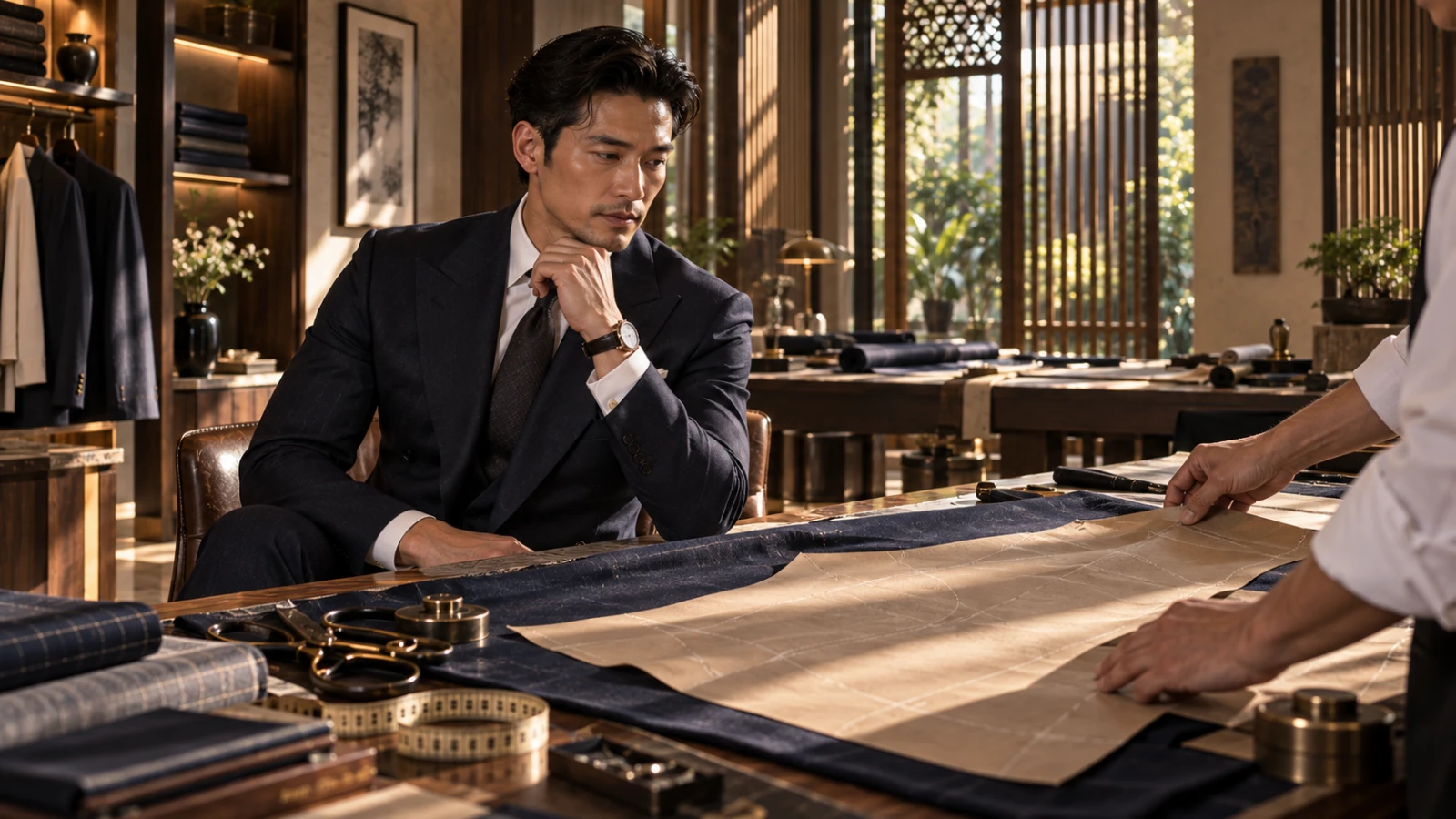
Bespoke Tailoring Chiang Mai: What Makes a Suit Truly Bespoke?
There is a moment in tailoring that is easy to miss because it happens before the cloth is cut. A good custom tailor looks at the person standing in front of him and stops thinking about clothing sizes cause he knows how to make a good Custom Suit Chiang Mai. The conversation shifts to posture, movement, work, climate, occasions, proportions and the way the wearer wants to be seen. That change in perspective is where bespoke begins. In a city such as Chiang Mai, where tailoring is part of the experience for residents, professionals, destination wedding couples and international visitors, the word “bespoke” is often used generously. Yet a suit can be custom-looking without being truly bespoke. The distinction matters because the value of a bespoke garment is not simply that it carries your measurements. It is that the garment is developed around you rather than asking your body to adapt to an existing template.
For someone researching Bespoke Tailoring Chiang Mai, the most useful question is therefore not, “How many fabrics can I choose?” or even, “How quickly can I get the suit?” A better question is, “How much of this suit is actually being created for me?” That question changes everything. It moves attention away from the showroom wall and toward the pattern, the fitting process, the relationship with the tailor, the construction of the jacket and the decisions that determine how the finished garment behaves when you walk, sit, work, travel or enter a room. Traditional bespoke tailoring is built around an individual pattern and a series of fittings, rather than simply modifying a standard size. Savile Row Bespoke, for example, describes a bespoke pattern as being made specifically for the customer, while Henry Poole describes the process as beginning with a personal paper pattern and continuing through staged fittings and refinements.
That distinction is particularly relevant in Chiang Mai. The city has a different rhythm. A client might be a local entrepreneur who needs a suit that moves comfortably between meetings and dinners, a traveller preparing for a wedding, an executive visiting Thailand for several days, or someone simply deciding that after years of ready-to-wear clothing, it is time to own something made properly. The circumstances are different, but the underlying expectation is similar: the suit should feel as though it belongs to the person wearing it. This is where Bespoke Tailoring Chiang Mai becomes less about terminology and more about the quality of decisions made throughout the process.
Bespoke Is About the Pattern, Not Just the Measurements
Measurements are important, but measurements alone do not make a suit bespoke. A tape can record chest, waist, sleeve length and inseam, yet two people with similar numbers can have completely different posture, shoulder balance, arm rotation, chest shape and stance. One may carry the head slightly forward. Another may have one shoulder lower than the other. One may stand naturally with the pelvis tilted differently from the other. A serious bespoke process interprets these differences rather than merely recording them.
The individual pattern is the quiet architecture behind the finished suit. It is one of the clearest markers of serious Bespoke Tailoring Chiang Mai. It translates the body from three dimensions into a cutting plan that determines how cloth will sit, hang and move. Traditional bespoke houses describe the personal paper pattern as a defining part of the process, with subsequent fittings used to refine the garment and, in some practices, the pattern itself for future commissions. This is one reason a bespoke suit can become more personal over time. In Bespoke Tailoring Chiang Mai, that individual pattern is also what separates a personal tailoring experience from a simple alteration service.
For a client comparing Bespoke Tailoring Chiang Mai options, this is one of the most useful things to ask about. A serious Bespoke Tailoring Chiang Mai consultation should make the pattern question clear before the order is confirmed. Does the tailor work from an individual pattern, or is an existing block simply adjusted? Is the fitting being used to discover how the garment should sit, or only to correct obvious sizing problems? Can the tailor explain what is happening at the shoulder, collar, chest and waist? The answers tell you more than a promise of a “perfect fit.”
The Fitting Is Where Bespoke Becomes Personal
A fitting should not be treated as a quick checkpoint between ordering and delivery. In Bespoke Tailoring Chiang Mai, the fitting is one of the moments when the promise of personalization becomes visible. When the unfinished garment is placed on the client, the tailor can see things that a measurement sheet cannot fully predict: how the jacket breaks at the chest, how the collar meets the neck, whether the shoulder follows the body’s natural slope, whether the sleeve hangs cleanly and whether the garment remains balanced when the wearer moves.
Traditional bespoke practice places considerable importance on intermediate fittings. Henry Poole’s published process, for instance, includes a first basted fitting, marking and adjustment, a second fitting and a final fitting, with alterations made along the way. The exact number of fittings appropriate to a garment can vary by tailor, construction, schedule and client requirements, but the principle is consistent: refinement happens through observation.
A fitting is therefore a conversation between fabric and body. That conversation is central to Bespoke Tailoring Chiang Mai because the finished suit must respond to the individual rather than merely resemble a chosen style. For local clients, the process can become more collaborative. A first suit can reveal preferences that were difficult to articulate at the beginning. Perhaps the wearer discovers that a slightly softer shoulder feels more natural, that a particular trouser rise is more comfortable when seated, or that a lighter cloth works better with the climate and daily routine. The next garment can then be more precise because the tailor has learned from the first.
Fit Means Balance, Movement and Comfort
A suit can be technically close and still feel wrong. Bespoke Tailoring Chiang Mai should solve that problem through balance, not compression.
Look at the shoulder first. It establishes the visual width of the jacket and strongly influences how the rest of the garment falls. Then consider the collar. It should sit naturally against the neck rather than creating an obvious gap or collapsing under movement. The chest should have enough room for the wearer to breathe and move without losing the intended silhouette. The jacket should remain balanced when standing and walking, while the sleeve should relate naturally to the arm. Trousers need their own attention: rise, seat, thigh, knee, hem and break all influence how the lower half of the suit supports the jacket.
The Chiang Mai climate adds another layer to this equation. That local reality should be considered from the beginning of any Bespoke Tailoring Chiang Mai commission. A suit that looks excellent under cool showroom lighting can become uncomfortable when worn outdoors in warm, humid conditions. That is why fabric weight, weave, breathability and the intended environment matter alongside measurements. A tropical-weight wool may behave differently from a heavier cloth; linen may offer a relaxed visual texture but crease more readily; blends can change drape, handle and performance. Local tailoring should therefore consider the actual life of the garment, not only its appearance at the moment of collection. Chiang Mai tailors commonly advise clients to choose fabrics according to climate, occasion and schedule, reflecting the practical reality that a formal garment must work beyond the fitting room.
For readers exploring Bespoke Tailoring Chiang Mai, this is an important commercial consideration as well as a style consideration. Good Bespoke Tailoring Chiang Mai should connect fabric choice with the way the client actually lives. The most expensive-looking fabric is not automatically the most useful fabric. A business traveller who spends hours moving between an air-conditioned conference room and a warm street may need a different cloth from a groom attending an evening celebration. A resident who wants a year-round wardrobe piece may prioritize versatility. A destination wedding client may accept more delicate cloth because the event itself is the priority.
The best bespoke decision is rarely “What is the fanciest option?” In Bespoke Tailoring Chiang Mai, the better question is what gives the wearer the right balance of elegance, comfort and purpose.
Fabric Is the Foundation of the Suit’s Character
Once fit is understood, fabric becomes more than a colour choice. It determines much of the suit’s visual language. The surface can appear dry and understated, softly lustrous, crisp, textured or fluid. The drape can be structured or relaxed. The weight can influence comfort, movement and the way the jacket holds its shape during a long day.
A refined wardrobe also benefits from thinking beyond individual garments. A first bespoke suit should usually have a clear purpose. Navy wool, charcoal, a lighter tropical fabric, a linen option or a distinctive evening cloth can each occupy different roles. This is where How to Build a Luxury Suit Wardrobe in Chiang Mai can become a useful next step for a reader who is thinking beyond one commission. The point is not to accumulate suits but to create a wardrobe in which each garment earns its place.
For Bespoke Tailoring Chiang Mai, fabric selection should also consider the destination of the finished suit. Chiang Mai offers business environments, resort settings, restaurants, weddings, cultural events and travel experiences within the same city. A suit designed only for a formal European winter climate may be technically beautiful but practically misplaced. Luxury is partly the freedom to choose, but expertise is knowing which choice makes sense.
The fabric should therefore support the pattern, the pattern should support the body, and the finished suit should support the life of the wearer. When those three layers agree, the garment feels unusually coherent.
Construction Changes What You Feel, Not Just What You See
The inside of a jacket is often where the difference between superficial customization and serious tailoring becomes clearer. This is another reason Bespoke Tailoring Chiang Mai deserves a process-based evaluation. A suit’s structure influences how it hangs, how it responds to movement and how it develops character over time. Interlinings, canvas, padding, stitching and finishing are not merely technical vocabulary. They affect the way the jacket communicates with the body.
Canvas construction, for example, can give a jacket a different degree of shape and response from a simpler fused construction. But construction should never be discussed as a competition where one method is automatically correct for every client. A lightweight tropical jacket has different priorities from a formal winter garment. The right question is whether the construction supports the intended silhouette, climate, durability and comfort.
Traditional bespoke houses place significant attention on internal construction and hand finishing. Savile Row Bespoke describes features including hand-shaped canvas, hand-set sleeves and hand-finished details as part of its formal bespoke standards. These traditions are useful reference points, but the broader lesson is more important than copying a particular house’s methods: craftsmanship should be visible in the garment’s behaviour, not simply in the vocabulary used to describe it.
A client considering Bespoke Tailoring Chiang Mai should be comfortable asking what is inside the jacket. The strongest Bespoke Tailoring Chiang Mai experience makes those construction choices understandable rather than mysterious. Is it fused, half canvassed or fully canvassed? What kind of structure is appropriate for the chosen cloth? Which details are hand finished, and which are machine made? What does the construction mean for comfort in Chiang Mai? A good tailor should be able to answer these questions without turning the consultation into a lecture.
Luxury becomes convincing when the technical choices make the garment better to wear. That is a practical definition of Bespoke Tailoring Chiang Mai worth remembering.
Personal Style Should Be Quietly Individual
Bespoke offers an extraordinary amount of choice, but unlimited choice can become its own problem. Bespoke Tailoring Chiang Mai should use choice intelligently, not simply offer more of it. Lapels, buttons, pockets, vents, lining, trousers, jacket length, stitching and other details all contribute to the final character. The goal is not to select the maximum number of options. In Bespoke Tailoring Chiang Mai, restraint can be sophisticated.
A timeless suit may use a restrained notch or peak lapel, a clean trouser line and a quiet lining. Another client may prefer a more pronounced silhouette, a distinctive fabric and details that reflect a creative profession. Neither approach is more bespoke. What matters is whether the choices form a coherent expression of the wearer.
This is where the relationship with the tailor becomes important. A good consultation includes moments when the tailor says yes, moments when the tailor says no, and moments when the tailor proposes a better alternative. If every idea is accepted simply because the client requested it, the process may feel accommodating but not necessarily expert. Bespoke is valuable because another trained eye is interpreting your preferences through the realities of proportion, construction and wear.
Aurex Suit approaches luxury tailoring from this perspective: individuality does not require noise. The strongest garment can be the one whose details emerge gradually.
What a Bespoke Consultation in Chiang Mai Should Feel Like
A first consultation should begin with questions, not a catalogue. That is the right starting point for Bespoke Tailoring Chiang Mai. Why do you need the suit? Where will you wear it? How often? What do you already own? What do you dislike about your current suits? Do you prefer a close modern silhouette or something more relaxed? How much time do you have in Chiang Mai? Will the garment travel? Will it be worn mostly indoors, outdoors, or across both?
Those questions create useful context before fabric and buttons enter the conversation. They also help distinguish genuine personalization from the simple appearance of choice.
For visitors, planning ahead can make the experience significantly better. Anyone booking Bespoke Tailoring Chiang Mai should share the event date and travel schedule early. If the suit is required for a wedding or business event, tell the tailor the date immediately. If you have only a few days, make that part of the first conversation rather than waiting until the final fitting. If you are staying around the Old City, Night Bazaar or Nimman area, think about how much time you can realistically spend travelling for fittings. Convenience matters, but it should support the fitting process rather than replace it.
For local customers, the consultation can be more exploratory. There is time to discuss a wardrobe rather than a single garment, compare cloths in different weights and consider whether the suit should become a foundation piece or a statement piece. The best result may be surprisingly restrained because the purpose is clear.
A useful internal-link opportunity here is a first custom suit in Chiang Mai, because a reader who is beginning the process will benefit from understanding what to expect before the appointment.
How to Tell Whether a Tailor Is Really Working Bespoke
The word “bespoke” alone is not enough evidence. A potential client should look for the process behind the promise. Ask how the pattern is created. Ask whether the tailor takes posture and shoulder balance into account. Ask what happens at the first fitting. Ask how adjustments are transferred back into the pattern. Ask who is responsible for the fitting and who makes the garment. Ask what construction is being used and why.
You should also pay attention to the conversation itself. Does the tailor ask about your lifestyle, or does the discussion immediately move toward choosing a colour? Does the tailor explain why a particular fabric works in the local climate? Are they willing to tell you when a requested style is unlikely to flatter your proportions? Do they explain what can realistically be achieved within your schedule?
For anyone researching Bespoke Tailoring Chiang Mai, transparency is one of the strongest indicators of quality. In good Bespoke Tailoring Chiang Mai, the client should understand both possibilities and limitations. A tailor who explains limitations honestly is often more trustworthy than one who promises everything immediately. That is a useful principle when choosing Bespoke Tailoring Chiang Mai.
The Chiang Mai Advantage Is Context
Chiang Mai is not simply a cheaper alternative to another tailoring destination. For Bespoke Tailoring Chiang Mai, the city’s climate and lifestyle are part of the design brief. A suit made here has to live in that environment.
That means a bespoke conversation can be more practical than purely ceremonial. The tailor needs to understand whether the client will wear the jacket in air-conditioned spaces, whether trousers must remain comfortable during travel, whether the garment will be packed into luggage, whether the occasion is daytime or evening, and whether the wearer expects to use the suit repeatedly after leaving Thailand.
This is why Luxury Tailoring in Chiang Mai should be understood as more than a product category. Bespoke Tailoring Chiang Mai is at its strongest when place and personal style inform one another. At its best, it is a relationship between place, craft and personal identity. The suit becomes a physical reminder of a particular period in someone’s life.
Bespoke Is a Process of Learning
You begin to notice how different cloths behave. You learn why a collar can change the appearance of the face, why jacket length affects proportion, why trousers can alter the visual balance of the entire body, and why a beautiful fabric is not necessarily the right fabric.
For someone making a first custom suit in Chiang Mai, the best approach is simple. You do not need to know every tailoring term before entering the studio. A good Bespoke Tailoring Chiang Mai consultation should teach you enough to make confident choices. You need to know yourself well enough to describe what you want to achieve. The tailor’s expertise should help translate that intention into technical decisions.
That is also why the most valuable question may not be, “How many choices do I get?” It may be, “How will you decide what is right for me?”
What Truly Makes Bespoke Tailoring Chiang Mai great ?
A truly bespoke suit is not defined by a gold button, an expensive cloth, a dramatic showroom or a long list of selectable details. It is defined by the depth of personalization built into the garment.
The pattern begins with the individual. That principle defines Bespoke Tailoring Chiang Mai. Measurements are interpreted rather than merely recorded. Posture and proportion influence the cut. The unfinished garment is fitted and observed. Adjustments are made because the body has spoken through the fitting. Construction is selected according to the intended garment rather than used as a marketing label. Fabric is chosen for appearance, climate and purpose. Style details are coordinated rather than collected randomly. The final suit is expected to move naturally with the person wearing it.
That is the standard worth looking for when researching Bespoke Tailoring Chiang Mai. It does not mean every bespoke suit must take months, use the same construction or imitate an old London tradition. Chiang Mai has its own practical realities, and a contemporary luxury tailoring experience can respond to those realities without abandoning the central principle of bespoke: the garment exists for the individual, not the other way around.
For a first-time client, the best approach is simple. Choose a tailor who is willing to understand your purpose, explain the process, discuss fabric honestly, fit the garment carefully and make decisions with you rather than merely taking an order. Bring the occasion, the climate, your wardrobe and your personality into the conversation. The more useful information you give, the more meaningful the tailor’s expertise becomes, which is one of the central strengths of Bespoke Tailoring Chiang Mai.
And when the finished jacket finally settles onto your shoulders, the difference should not need to be announced. You should feel it in the balance, see it in the silhouette and notice it when you move. That quiet sense of rightness is the real promise of bespoke. It is also the point at which Bespoke Tailoring Chiang Mai becomes more than a search phrase and becomes an experience.
In the end, Bespoke Tailoring Chiang Mai is valuable not because the word sounds luxurious, but because true bespoke tailoring asks a more thoughtful question than standard clothing does: how should this garment be made for this particular person? When the answer shapes the pattern, the fabric, the construction, the fitting and the final details, a suit stops being merely something you wear. It becomes something that has been considered around you.
That is what makes a suit truly bespoke.

