
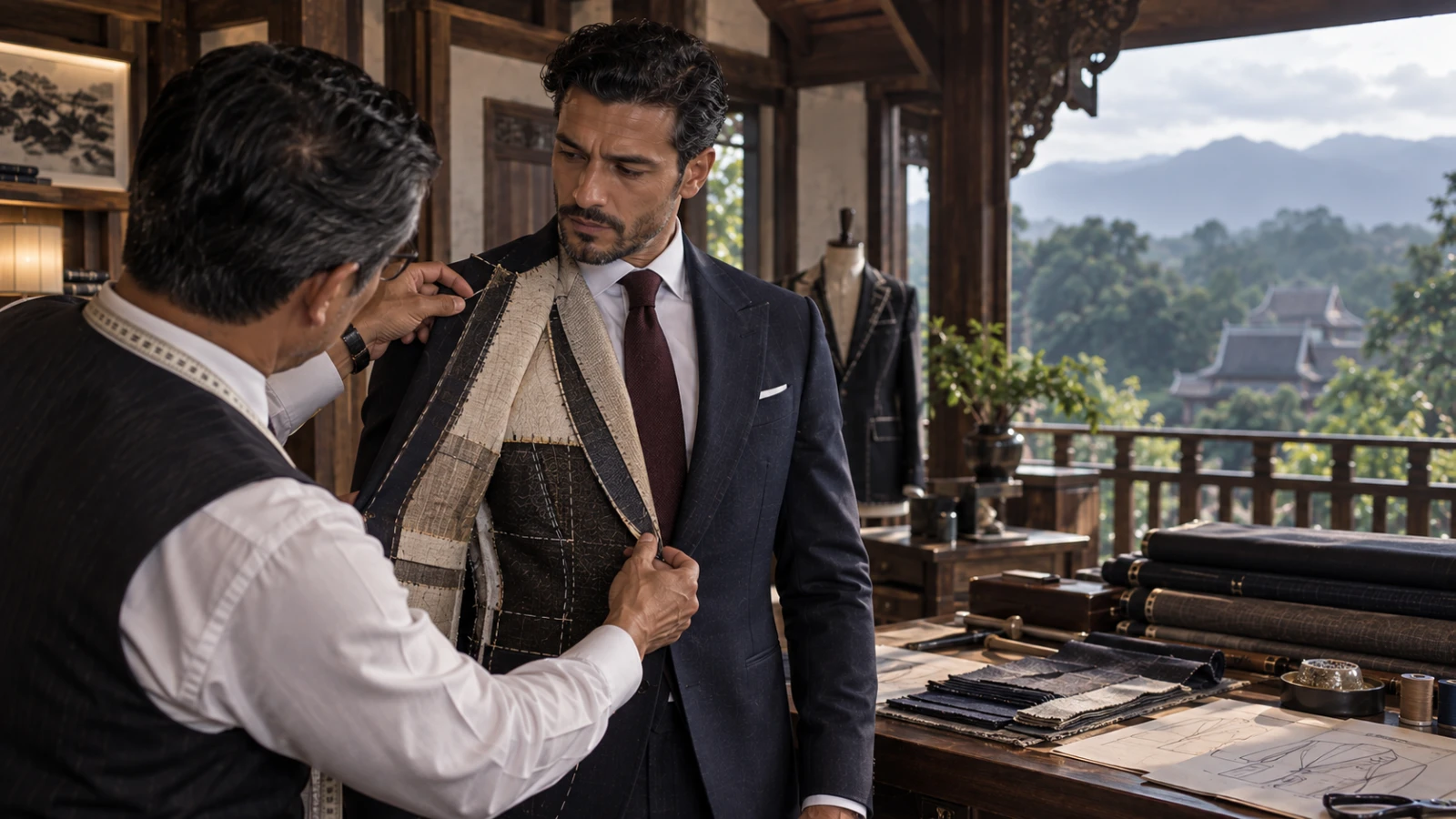
Bespoke Suit Construction Chiang Mai: What Goes Inside a Quality Suit?
Bespoke Suit Construction Chiang Mai is not simply about choosing a fine fabric and taking measurements. For someone exploring luxury tailoring, understanding these hidden elements is useful before commissioning premium suits. Much of a suit’s character is determined by what cannot be seen from the outside: the canvas, interlinings, shoulder structure, chest shaping, stitching and the way these components work together. A beautiful outer cloth matters, but the internal construction determines how that cloth behaves on the body.
A quality suit should feel balanced when worn, retain its shape without becoming rigid, and move naturally when the wearer walks, sits or reaches across a table. That requires more than a good-looking pattern. It requires a considered relationship between materials, craftsmanship and the individual body.
In Chiang Mai, construction also needs to make sense for the climate and lifestyle. A jacket intended for warm-weather business meetings has different requirements from a formal evening garment or a wedding suit. This is why a serious discussion about Bespoke Suit Construction Chiang Mai should begin inside the jacket rather than at the button or lapel.
What Does Suit Construction Actually Mean while searching for Bespoke Suit Construction Chiang Mai?
Suit construction describes the internal method used to build a jacket and connect its outer cloth to the supporting layers underneath. These layers help create shape, stability and drape. They also influence how the garment feels after hours of wear.
The outer fabric is only the visible surface. Underneath it may be canvas, fusible interlining, shoulder components, chest pieces, sleeve heads and other structural materials. The exact combination varies according to the construction method and the design objective.
When discussing Bespoke Suit Construction Chiang Mai, it is useful to separate construction from fit. Fit describes how the garment relates to the wearer’s body. Construction describes how the garment itself is engineered. They are different, but they cannot be treated independently.
A superb internal construction cannot rescue an inaccurate pattern, while an excellent pattern may perform differently depending on the materials supporting it. The best results come when both are considered together.
In Bespoke Suit Construction Chiang Mai – The Three Construction Approaches
The terms fused, half-canvas and full-canvas are commonly used when discussing tailored jackets. They describe different ways of creating the internal structure.
A fused jacket uses adhesive to attach the interlining to the outer fabric. This method can produce a clean appearance efficiently and is widely used in ready-to-wear clothing. It can also be appropriate for certain garments where lightweight construction and production efficiency are priorities.
A half-canvas jacket introduces a natural or semi-natural canvas through the upper chest and lapel area while the lower section remains fused. This can provide more shaping and a more natural roll through the lapel without the full complexity of a completely canvassed jacket.
A full-canvas jacket uses canvas extending through the front of the jacket, allowing the outer cloth and internal structure to interact more naturally. It is traditionally associated with higher levels of tailoring craftsmanship because the construction requires more work and precision.
The important point is that construction should be judged in context. Bespoke Suit Construction Chiang Mai is not automatically superior simply because a particular construction term sounds more luxurious. The materials, workmanship, pattern and intended use all matter.
For a client seeking Bespoke Suit Construction Chiang Mai, the construction method should be discussed alongside the fabric and silhouette rather than selected as an isolated status symbol.
In Bespoke Suit Construction Chiang Mai What Is Canvas and Why Does It Matter?
Canvas is an internal structural layer traditionally made from materials such as wool, hair or blends. It sits between the outer cloth and the lining and helps the jacket develop its shape.
Unlike an adhesive layer, a properly integrated canvas can allow the cloth to respond more naturally to movement. Over time, the outer fabric and internal structure can settle together, helping the jacket develop a distinctive drape.
The chest area is particularly important. A quality jacket does not simply hang flat from the shoulders. It needs controlled shaping through the chest and lapel. Canvas contributes to that process.
When examining Bespoke Suit Construction Chiang Mai, the canvas is therefore one of the most useful concepts for a client to understand. It is not visible once the jacket is finished, but it can influence how the garment feels and ages.
That does not mean every warm-weather suit requires the heaviest possible canvas. A lighter construction may be more appropriate for Chiang Mai. The objective is balance rather than maximum internal structure.
In Bespoke Suit Construction Chiang Mai The Chest and Lapel Tell a Story
The lapel is one of the most noticeable areas of a jacket, but its appearance depends partly on what happens underneath.
A well-constructed lapel has a natural roll rather than looking like a flat strip of fabric attached to the front. The chest canvas and stitching help create that three-dimensional shape.
Different tailoring traditions approach this in different ways. Some jackets have a stronger roll and more pronounced structure, while others are intentionally soft and relaxed.
For a client considering Bespoke Suit Construction Chiang Mai, the lapel should therefore be evaluated as part of the whole jacket. Width, shape, roll and stiffness should work with the wearer’s body and the intended style.
A formal business suit may benefit from a clearer structure. A relaxed summer jacket may look better with a softer expression. Neither approach is automatically correct.
Getting Bespoke Suit Construction Chiang Mai now thinking What Is Fusing??
Fusing uses heat and adhesive to connect an interlining to the outer fabric. It is an efficient way to provide stability and shape.
Fusing itself is not inherently a sign of poor clothing. Modern manufacturing can use sophisticated fusible materials, and a well-executed fused garment can look clean and perform appropriately.
The difference becomes more apparent when considering the character of the finished garment. A fully fused construction may have a different lapel roll, chest feel and long-term behaviour from a jacket built around a floating canvas.
This is why clients should avoid reducing tailoring quality to one technical word. Bespoke Suit Construction Chiang Mai should be evaluated through the complete garment and its intended use.
A lightweight summer jacket, for example, may benefit from minimal structure. A formal suit designed for a pronounced silhouette may require more internal support.
In Bespoke Suit Construction Chiang Mai Shoulder Construction and Balance
The shoulder is the foundation of the jacket silhouette. It determines how the garment begins at the neck and extends toward the sleeve.
Padding can create a stronger shoulder line, while minimal padding can produce a softer natural shoulder. The right approach depends on the wearer’s anatomy and desired style.
Shoulder slope matters too. People do not have identical shoulders. One side may sit differently from the other, and posture can influence the way the jacket hangs.
A skilled approach to Bespoke Suit Construction Chiang Mai considers these variations rather than forcing every client into the same shoulder shape. The goal is a balanced silhouette that looks natural from the front, side and back.
For professional clothing, this can be especially valuable. A controlled shoulder line can communicate polish without making the jacket appear artificially rigid.
Sleeve Heads and Armholes
The sleeve is not simply a tube attached to the jacket.
Its pitch, width, head and relationship to the armhole influence both movement and appearance. A well-positioned sleeve can hang cleanly when the arm is relaxed and remain comfortable when the wearer moves.
The armhole also deserves attention. A higher, properly shaped armhole can provide surprisingly good freedom of movement because it allows the jacket body to remain stable while the arm moves independently.
This is one of the less obvious aspects of Bespoke Suit Construction Chiang Mai. A jacket can feel restrictive even when it appears loose if the armhole and sleeve relationship is poorly designed.
For someone who wears a suit throughout a working day, these details can make the difference between clothing that is tolerated and clothing that feels natural.
Why Stitching Matters in Bespoke Suit Construction Chiang Mai
Tailoring contains a surprising amount of invisible craftsmanship.
Stitching can help secure canvas, shape the lapel, attach internal components and stabilize areas that experience repeated movement. Handwork and machine work may both have their place depending on the garment and construction.
Certain techniques allow more subtle shaping than industrial shortcuts. However, hand stitching should not be treated as a magic word. The quality of the execution matters more than the mere presence of visible handwork.
A thoughtful discussion of Bespoke Suit Construction Chiang Mai should therefore focus on what the stitching achieves. Does it improve the roll of the lapel? Does it secure the canvas effectively? Does it help the garment maintain its shape?
Craftsmanship has value when it produces a meaningful result.
While getting Bespoke Suit Construction Chiang Mai The Lining Has a Practical Role
The lining is visible when the jacket opens, but its purpose is not simply decorative.
It helps the jacket slide over a shirt and can protect internal construction from direct friction. The choice of lining material also affects comfort and weight.
In Chiang Mai, breathable and lightweight considerations can be particularly relevant. A heavy synthetic lining may add unnecessary warmth to a jacket that is already designed for a hot environment.
The lining can also become a subtle opportunity for personalization. A restrained solid colour may support a conservative business suit, while a distinctive pattern can add private character without changing the exterior appearance.
The best Bespoke Suit Construction Chiang Mai approach considers lining as part of the garment’s performance rather than an afterthought.
Why Lightweight Construction Matters in Chiang Mai
Northern Thailand changes the practical conversation about tailoring.
A jacket can be beautifully constructed and still be unsuitable if it is too heavy for the environment in which it will be worn. Warm temperatures, outdoor movement and transitions between air-conditioned rooms and open spaces all influence comfort.
That is why lightweight construction can be valuable. Reducing unnecessary layers can make the jacket easier to wear while preserving enough structure for an elegant silhouette.
Bespoke Suit Construction Chiang Mai should therefore be adapted to the climate rather than copied mechanically from colder tailoring traditions.
A client who needs a suit for daily professional use may want a different internal architecture from someone commissioning an evening garment. The former may prioritize breathability and mobility, while the latter may accept additional structure for a more formal appearance.
For clients interested in Bespoke Suit Construction Chiang Mai, climate should be treated as part of the construction brief from the beginning.
Fit and Construction Must Work Together
It is tempting to think that bespoke tailoring is mainly about measurements. Measurements are important, but they are only one part of the process.
The pattern interprets those measurements. Construction then determines how the resulting garment holds and expresses that shape.
For example, a jacket may have the correct chest measurement but still feel wrong if the shoulder balance is inaccurate. A sleeve can have the right length but sit poorly because the pitch does not correspond with the wearer’s posture.
This is why Bespoke Suit Construction Chiang Mai should be understood as an integrated process. The tailor needs to observe the person, not simply record numbers.
Movement also matters. The client should be able to sit, walk and use his arms without constantly adjusting the garment.
How Construction Affects Longevity
A quality suit should not only look good when it leaves the studio. It should continue to perform after repeated wear.
Internal construction influences how a jacket responds to pressing, movement and time. Natural canvas can develop a distinctive relationship with the cloth as the garment is worn. Fused structures can behave differently depending on materials and manufacturing quality.
Longevity also depends on care. Even a beautifully constructed suit needs proper hanging, brushing, cleaning and periodic pressing.
For clients investing in luxury tailoring in Chiang Mai, understanding maintenance is part of understanding value. A suit that is cared for properly has a better chance of remaining useful for years.
The goal is not to make a garment indestructible. It is to create something that can age gracefully while retaining its essential shape and character.
What Should a Client Ask a Tailor?
A client does not need to become a tailoring expert before commissioning a suit. A few straightforward questions can reveal how the garment will be built.
Ask what construction method is being used. Ask whether the jacket is fused, half-canvas or full-canvas. Ask what type of canvas or interlining is involved. Ask how the shoulders are structured and what approach is recommended for the climate.
Then ask about the fitting process. How many fittings are expected? How are posture differences handled? How are alterations assessed?
For someone considering Bespoke Suit Construction Chiang Mai, these questions are more useful than simply asking whether a suit is “premium.”
A good consultation should explain the reasoning behind the recommendations. The client should understand what he is paying for and why one construction may be more appropriate than another.
This is also where custom suits become different from simply buying a standard garment in a smaller or larger size. The discussion should concern the individual rather than only the finished silhouette.
Construction for Business Suits
Professional clothing places particular demands on construction.
A business suit may be worn repeatedly, sometimes for long days. It needs to maintain a polished silhouette while allowing movement and reasonable comfort.
A structured navy or charcoal suit can benefit from a controlled shoulder and clean chest shaping, while a softer professional jacket may use lighter construction.
Clients building a professional wardrobe can also coordinate their tailoring with business suits already in their collection. The goal is to create variation without sacrificing consistency.
Construction should therefore reflect frequency of use. A suit worn every week should be approached differently from a ceremonial garment worn twice a year.
A practical professional wardrobe may also benefit from custom shirts that work naturally with the jacket proportions. Collar height, cuff visibility and shirt length can all influence how the finished suit appears.
Construction for Wedding and Formal Wear
Wedding clothing creates a different set of priorities.
The garment will be photographed extensively and may need to remain comfortable from ceremony to reception. The groom may spend time outdoors, sit during dinner and move through many photographs.
A formal wedding suit can therefore require a balance between structure and comfort.
For clients planning wedding suits, construction should be considered alongside fabric, venue and season. A heavy structured jacket may look magnificent indoors but become difficult during a warm outdoor ceremony.
The right internal construction can preserve an elegant silhouette without adding unnecessary weight.
For a groom seeking a more specialized formal wardrobe, the construction can also be coordinated with formal eveningwear so that each garment has a distinct purpose rather than becoming a collection of similar jackets.
What “Bespoke” Should Mean
The word bespoke is sometimes used loosely in the tailoring industry, so it is worth focusing on the underlying principle.
True bespoke thinking begins with the individual. The garment is developed around the person’s measurements, posture, preferences and intended use rather than simply selecting the nearest standard size.
That does not mean every bespoke garment must contain the same construction method or the maximum amount of handwork.
Bespoke Suit Construction Chiang Mai should instead be judged by how thoughtfully the internal architecture supports the individual garment. A lightweight jacket may require a different solution from a formal structured coat.
The best construction is the one that makes sense for the person, fabric and purpose.
Choosing Fabric and Construction Together
Fabric should never be selected independently from construction.
A lightweight tropical wool may benefit from a lighter internal structure. A substantial formal cloth can support more body. A soft luxury fabric may need careful handling during construction to preserve its natural drape.
This relationship becomes particularly important in Chiang Mai because climate can magnify differences in comfort.
When considering Bespoke Suit Construction Chiang Mai, clients should bring the fabric discussion into the construction discussion. Ask how the chosen cloth will be structured, how much internal support it needs and how the final garment is expected to feel.
The result should be a unified design rather than a collection of expensive components.
For clients comparing Italian suit fabrics, the same principle applies: the cloth should be selected with the intended construction rather than treated as an independent luxury upgrade.
How Construction Influences the Finished Silhouette
A suit’s silhouette is the visible result of many hidden decisions.
The shoulder determines the starting point. The canvas helps shape the chest. The lapel develops its roll. The sleeve follows the arm. The trouser pattern balances the jacket.
When those elements work together, the suit can look remarkably effortless.
This is one reason Bespoke Suit Construction Chiang Mai deserves attention before the final design is approved. A client may prefer a close contemporary silhouette, a classic business shape or a relaxed Italian-inspired cut. Each requires different decisions inside the garment.
The objective is not to create maximum structure. It is to create the right structure.
That distinction is particularly important in Chiang Mai, where comfort and breathability need to coexist with a polished appearance.
The Relationship Between Craftsmanship and Comfort with Bespoke Suit Construction Chiang Mai
Luxury tailoring sometimes gets described through technical terms, but the wearer ultimately experiences something simpler: comfort.
A jacket with appropriate internal architecture should move with the body rather than constantly fighting it. The shoulder should sit naturally. The sleeve should move without pulling the jacket excessively. The chest should provide shape without feeling restrictive.
Bespoke Suit Construction Chiang Mai becomes successful when those technical decisions translate into everyday comfort.
This is especially relevant for people who wear tailored clothing for long meetings, weddings or travel. A suit that looks impressive for ten minutes but becomes uncomfortable after several hours is not fulfilling its full purpose.
Good craftsmanship should therefore be felt through ease rather than noticed through complication.
Aurex Suit and the Invisible Side of Luxury : Our role in your Bespoke Suit Construction Chiang Mai
At Aurex Suit, the most interesting part of luxury tailoring is often what the wearer does not immediately see.
A refined exterior is important, but the hidden architecture of a jacket influences how that exterior behaves. The canvas, shoulder, lapel, sleeve and lining all contribute to the final experience.
Bespoke Suit Construction Chiang Mai becomes meaningful when these components are selected according to the person rather than treated as a checklist.
The objective is not to overwhelm the client with technical terminology. It is to create a garment in which technical decisions become almost invisible because the finished suit simply feels right.
That is a more useful definition of luxury than adding complexity for its own sake.
Making the Right Choice about Bespoke Suit Construction Chiang Mai
Understanding what goes inside a suit changes the way a client evaluates tailoring.
Instead of looking only at fabric names, buttons or visible details, it becomes possible to ask deeper questions. How is the jacket structured? How does the lapel roll? What supports the chest? How is the shoulder shaped? Does the construction suit Chiang Mai’s climate? Is the garment designed around the way it will actually be worn?
Bespoke Suit Construction Chiang Mai is ultimately about answering those questions with precision.
A quality suit should not feel unnecessarily heavy, rigid or complicated. It should feel balanced. The wearer should notice the comfort, movement and confidence of the garment rather than constantly thinking about its internal engineering.
That is the paradox of good tailoring: considerable craftsmanship can disappear into the final result.
The finest construction is not necessarily the one with the most technical features. It is the one that gives the fabric the right support, gives the body the right freedom and gives the finished suit the right character.
For a client choosing a bespoke suit in Chiang Mai, understanding that hidden architecture can make the entire tailoring experience more informed. Once the inside of the jacket makes sense, the outside begins to make sense too.

